Generate a simulated cross-sectional sample and estimate seroincidence
Simulation of Enteric Fever using HlyE IgG and/or HlyE IgA
Source:vignettes/articles/simulate_xsectionalData.Rmd
simulate_xsectionalData.RmdThis vignette shows how to simulate a cross-sectional sample of
seroresponses for incident infections as a Poisson process with
frequency lambda. Responses are generated for the
antibodies given in the antigen_isos argument.
Age range of the simulated cross-sectional record is
lifespan.
The size of the sample is nrep.
Each individual is simulated separately, but different antibodies are modelled jointly.
Longitudinal parameters are calculated for an age:
age_fixed (fixed age). However, when age_fixed
is set to NA then the age at infection is used.
The boolean renew_params determines whether each
infection uses a new set of longitudinal parameters, sampled at random
from the posterior predictive output of the longitudinal model. If set
to FALSE, a parameter set is chosen at birth and kept,
but:
the baseline antibody levels (
y0) are updated with the simulated level (just) prior to infection, andwhen
age_fixed = NA, the selected parameter sample is updated for the age when infection occurs.
For our initial simulations, we will set
renew_params = FALSE:
renew_params <- FALSEThere is also a variable n_mcmc_samples: when
n_mcmc_samples==0 then a random MC sample is chosen out of
the posterior set (1:4000). When n_mcmc_samples is given a
value in 1:4000, the chosen number is fixed and reused in any subsequent
infection. This is for diagnostic purposes.
Simulate a single dataset
load model parameters
Here we load in longitudinal parameters; these are modeled from all SEES cases across all ages and countries:
library(serocalculator)
library(tidyverse)
#> ── Attaching core tidyverse packages ──────────────────────── tidyverse 2.0.0 ──
#> ✔ dplyr     1.1.4     ✔ readr     2.1.5
#> ✔ forcats   1.0.0     ✔ stringr   1.5.1
#> ✔ ggplot2   3.5.1     ✔ tibble    3.2.1
#> ✔ lubridate 1.9.4     ✔ tidyr     1.3.1
#> ✔ purrr     1.0.2
#> ── Conflicts ────────────────────────────────────────── tidyverse_conflicts() ──
#> ✖ dplyr::filter() masks stats::filter()
#> ✖ dplyr::lag()    masks stats::lag()
#> ℹ Use the conflicted package (<http://conflicted.r-lib.org/>) to force all conflicts to become errors
library(ggbeeswarm) # for plotting
library(dplyr)
dmcmc <-
  "https://osf.io/download/rtw5k" |>
  load_curve_params() |>
  dplyr::filter(iter < 500) # reduce number of mcmc samples for speed
visualize antibody decay model
We can graph individual MCMC samples from the posterior distribution
of model parameters using a autoplot.curve_params() method
for the autoplot() function:
dmcmc |> autoplot(n_curves = 50)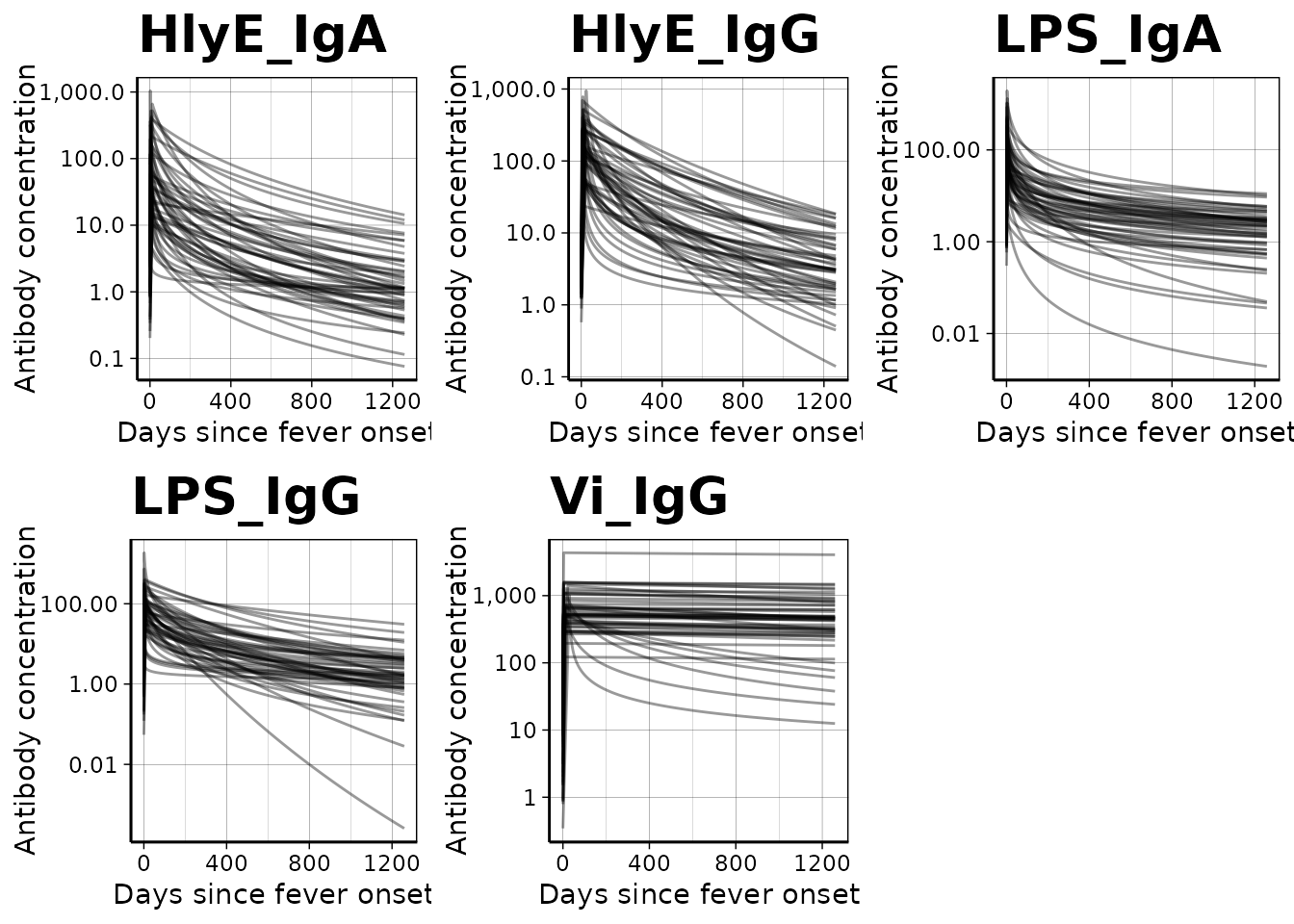
We can use a logarithmic scale for the x-axis if desired:
dmcmc |> autoplot(log_x = TRUE, n_curves = 50)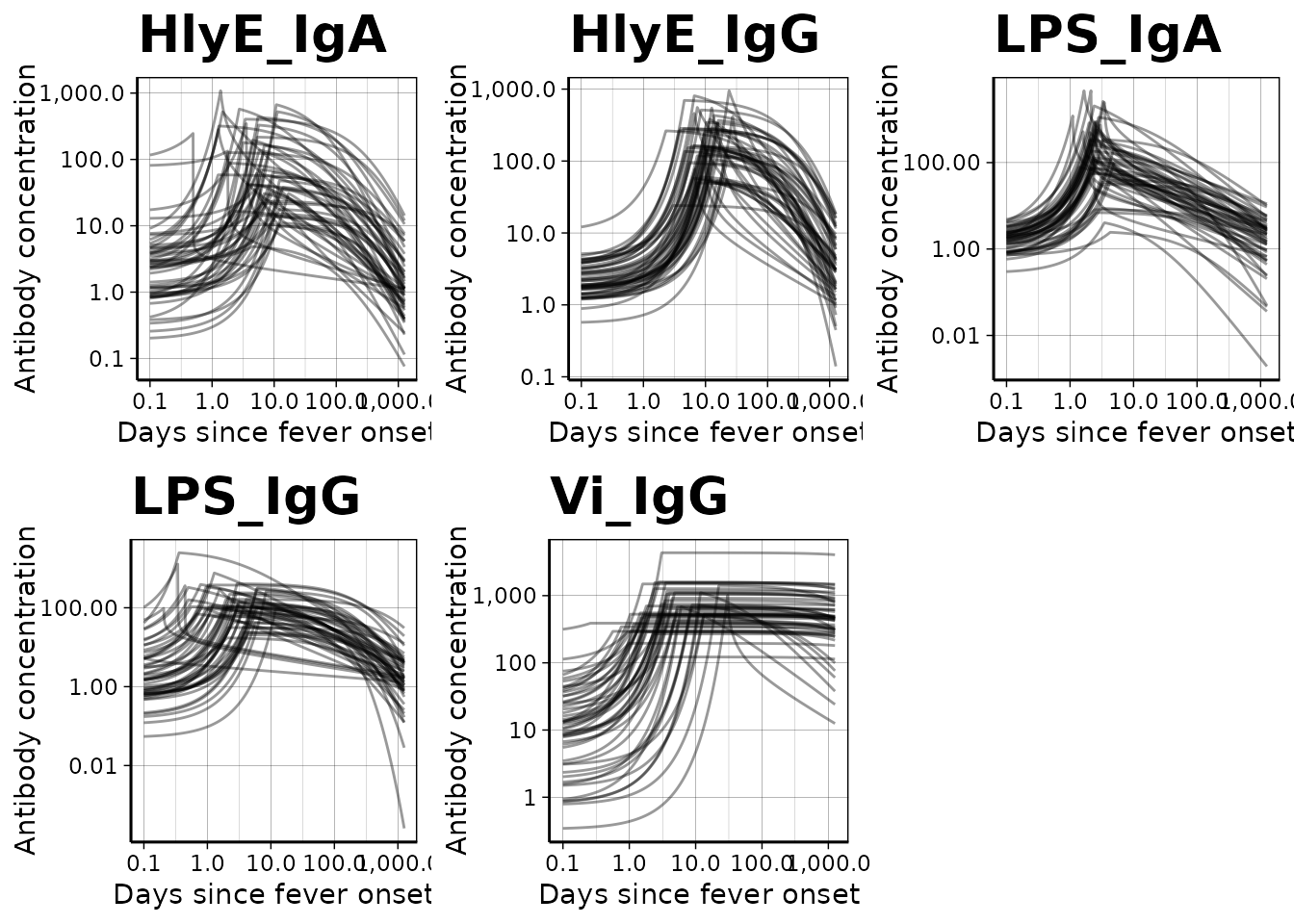
We can graph the median, 10%, and 90% quantiles of the model using
the graph.curve.params() function:
# Specify the antibody-isotype responses to include in analyses
antibodies <- c("HlyE_IgA", "HlyE_IgG")

dmcmc |>
  graph.curve.params(antigen_isos = antibodies) |>
  print()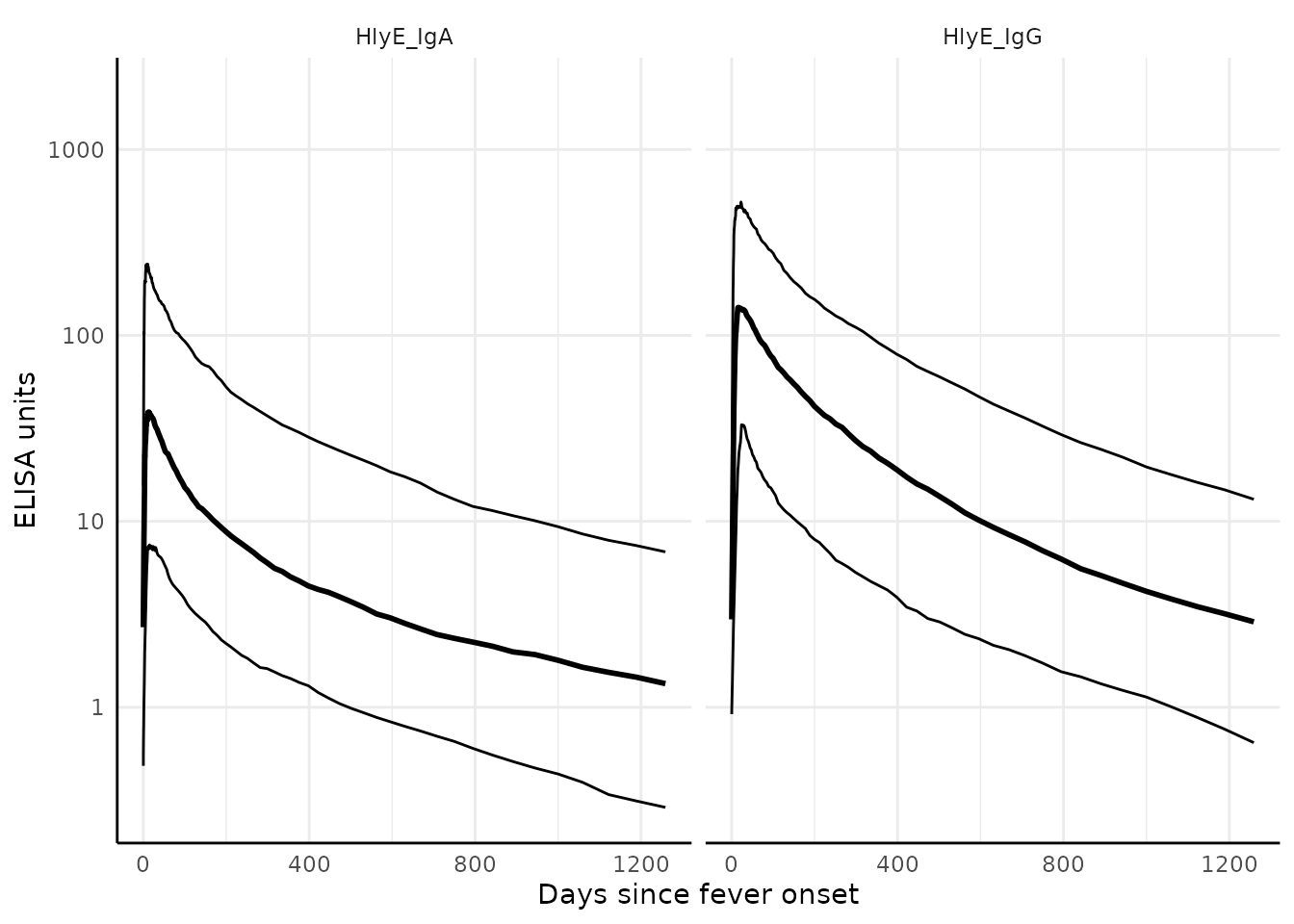
Simulate cross-sectional data
# set seed to reproduce results
set.seed(54321)

# simulated incidence rate per person-year
lambda <- 0.2
# range covered in simulations
lifespan <- c(0, 10)
# cross-sectional sample size
nrep <- 100

# biologic noise distribution
dlims <- rbind(
  "HlyE_IgA" = c(min = 0, max = 0.5),
  "HlyE_IgG" = c(min = 0, max = 0.5)
)
verbose <- FALSE # whether to print verbose updates as the function runs

# generate cross-sectional data
csdata <- sim_pop_data(
  curve_params = dmcmc,
  lambda = lambda,
  n_samples = nrep,
  age_range = lifespan,
  antigen_isos = antibodies,
  n_mcmc_samples = 0,
  renew_params = renew_params,
  add_noise = TRUE,
  noise_limits = dlims,
  format = "long"
)
Noise parameters
We need to provide noise parameters for the analysis; here, we define them directly in our code:
Visualize data
We can plot the distribution of the antibody responses in the simulated data.
csdata |>
  ggplot() +
  aes(x = as.factor(antigen_iso),
      y = value) +
  geom_beeswarm(
    size = .2,
    alpha = .3,
    aes(color = antigen_iso),
    show.legend = FALSE
  ) +
  geom_boxplot(outlier.colour = NA, fill = NA) +
  scale_y_log10() +
  theme_linedraw() +
  labs(x = "antigen - isotype")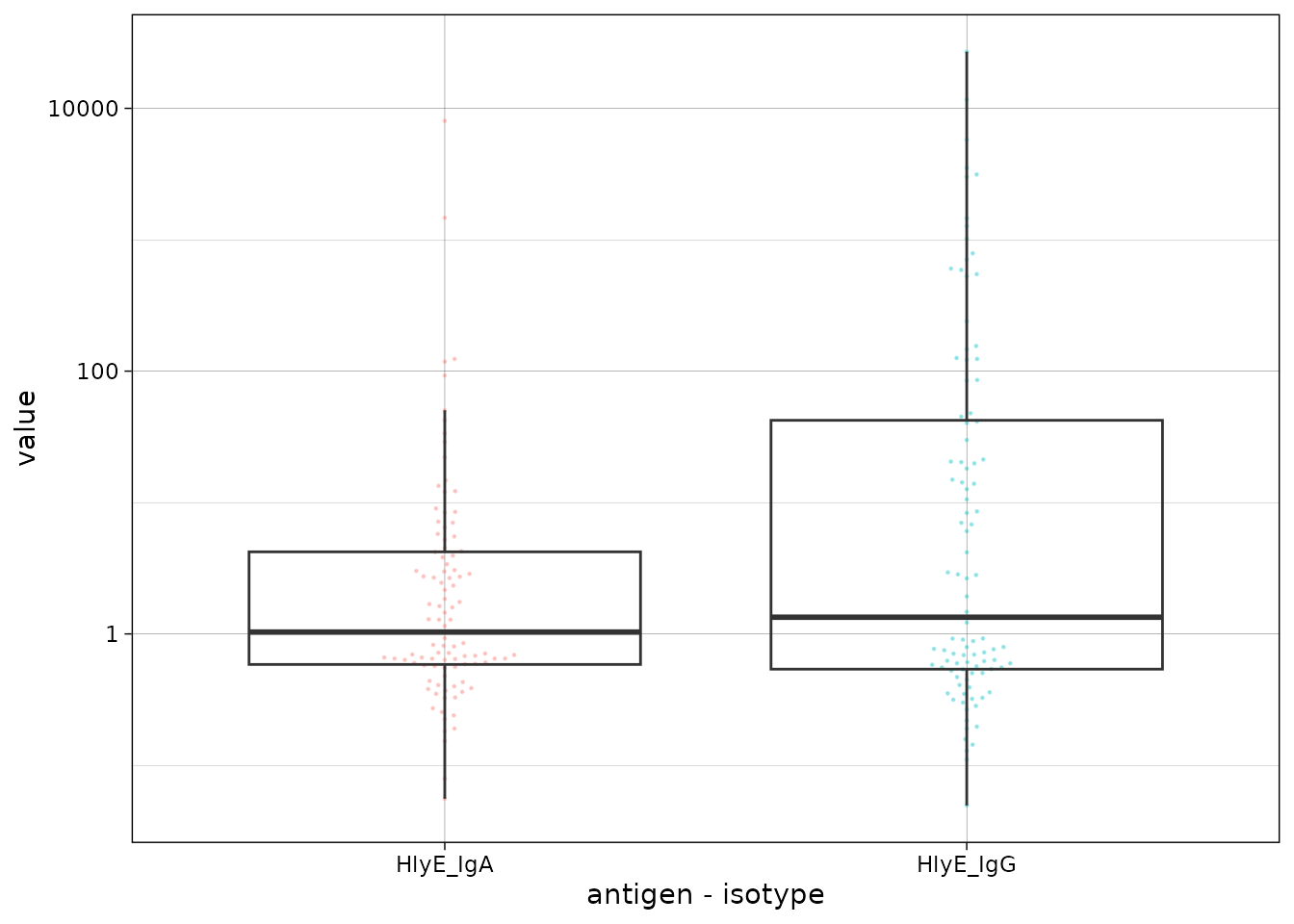
calculate log-likelihood
We can calculate the log-likelihood of the data as a function of the incidence rate directly:
ll_a <-
  log_likelihood(
    pop_data = csdata,
    curve_params = dmcmc,
    noise_params = cond,
    antigen_isos = "HlyE_IgA",
    lambda = 0.1
  ) |>
  print()
#> [1] -266.4948

ll_g <-
  log_likelihood(
    pop_data = csdata,
    curve_params = dmcmc,
    noise_params = cond,
    antigen_isos = "HlyE_IgG",
    lambda = 0.1
  ) |>
  print()
#> [1] -406.6665

ll_ag <-
  log_likelihood(
    pop_data = csdata,
    curve_params = dmcmc,
    noise_params = cond,
    antigen_isos = c("HlyE_IgG", "HlyE_IgA"),
    lambda = 0.1
  ) |>
  print()
#> [1] -673.1613

print(ll_a + ll_g)
#> [1] -673.1613
graph log-likelihood
We can also graph the log-likelihoods, even without finding the MLEs,
using graph_loglik():
lik_HlyE_IgA <-
  graph_loglik(
    pop_data = csdata,
    curve_params = dmcmc,
    noise_params = cond,
    antigen_isos = "HlyE_IgA",
    log_x = TRUE
  )

lik_HlyE_IgG <- graph_loglik(
  previous_plot = lik_HlyE_IgA,
  pop_data = csdata,
  curve_params = dmcmc,
  noise_params = cond,
  antigen_isos = "HlyE_IgG",
  log_x = TRUE
)

lik_both <- graph_loglik(
  previous_plot = lik_HlyE_IgG,
  pop_data = csdata,
  curve_params = dmcmc,
  noise_params = cond,
  antigen_isos = c("HlyE_IgG", "HlyE_IgA"),
  log_x = TRUE
)

print(lik_both)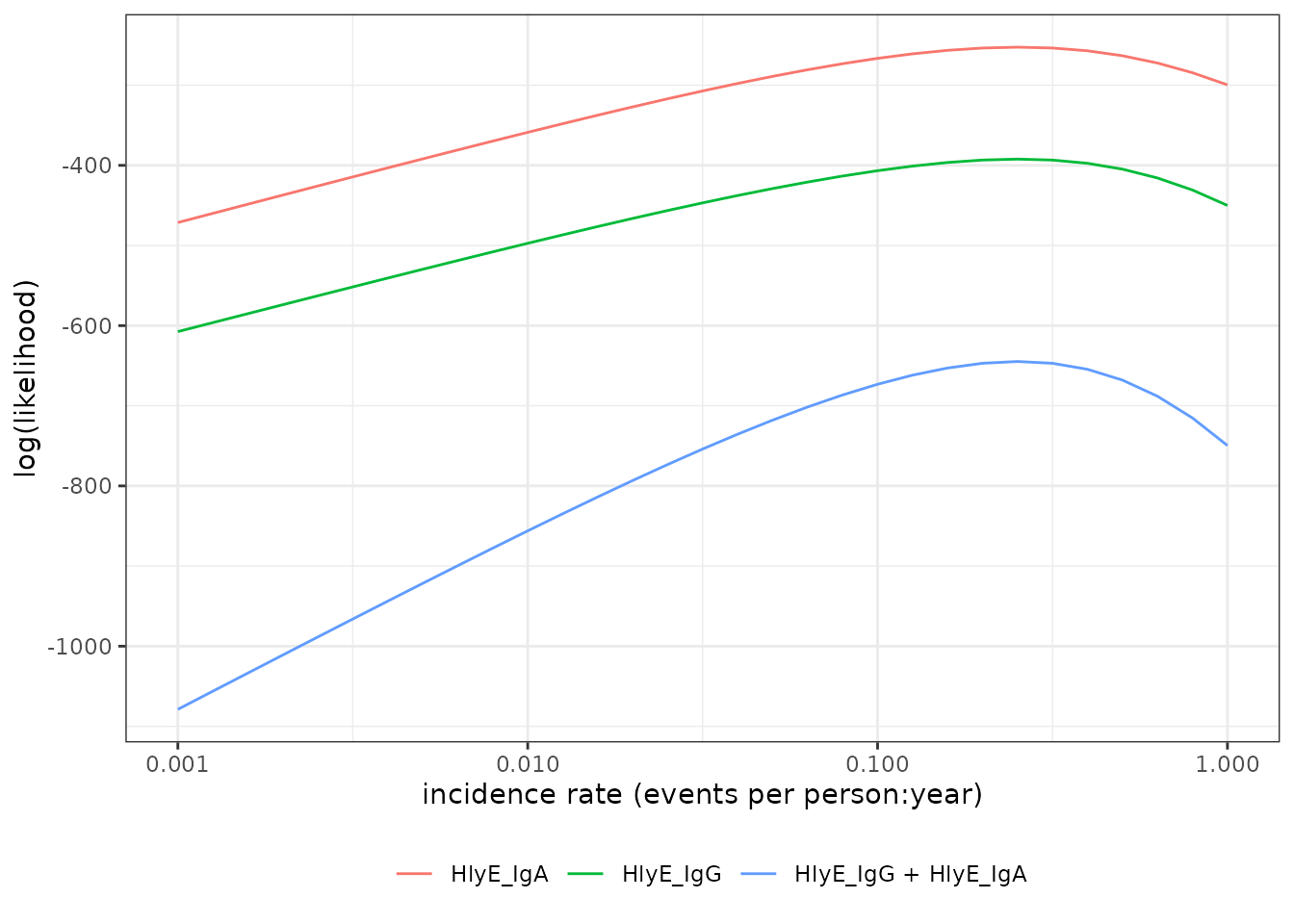
estimate incidence
We can estimate incidence with est.incidence():
est1 <- est.incidence(
  pop_data = csdata,
  curve_params = dmcmc,
  noise_params = cond,
  lambda_start = .1,
  build_graph = TRUE,
  verbose = verbose,
  print_graph = FALSE, # display the log-likelihood curve while
  #`est.incidence()` is running
  antigen_isos = antibodies
)
We can extract summary statistics with summary():
summary(est1)
#> Warning: `nlm()` produced a negative hessian; something is wrong with the numerical
#> derivatives.
#> Warning in sqrt(var_log_lambda): NaNs produced
#> # A tibble: 1 × 10
#>   est.start incidence.rate    SE CI.lwr CI.upr coverage log.lik iterations
#>       <dbl>          <dbl> <dbl>  <dbl>  <dbl>    <dbl>   <dbl>      <int>
#> 1       0.1          0.253   NaN    NaN    NaN     0.95   -645.          9
#> # ℹ 2 more variables: antigen.isos <chr>, nlm.convergence.code <ord>
We can plot the log-likelihood curve with
autoplot():
autoplot(est1)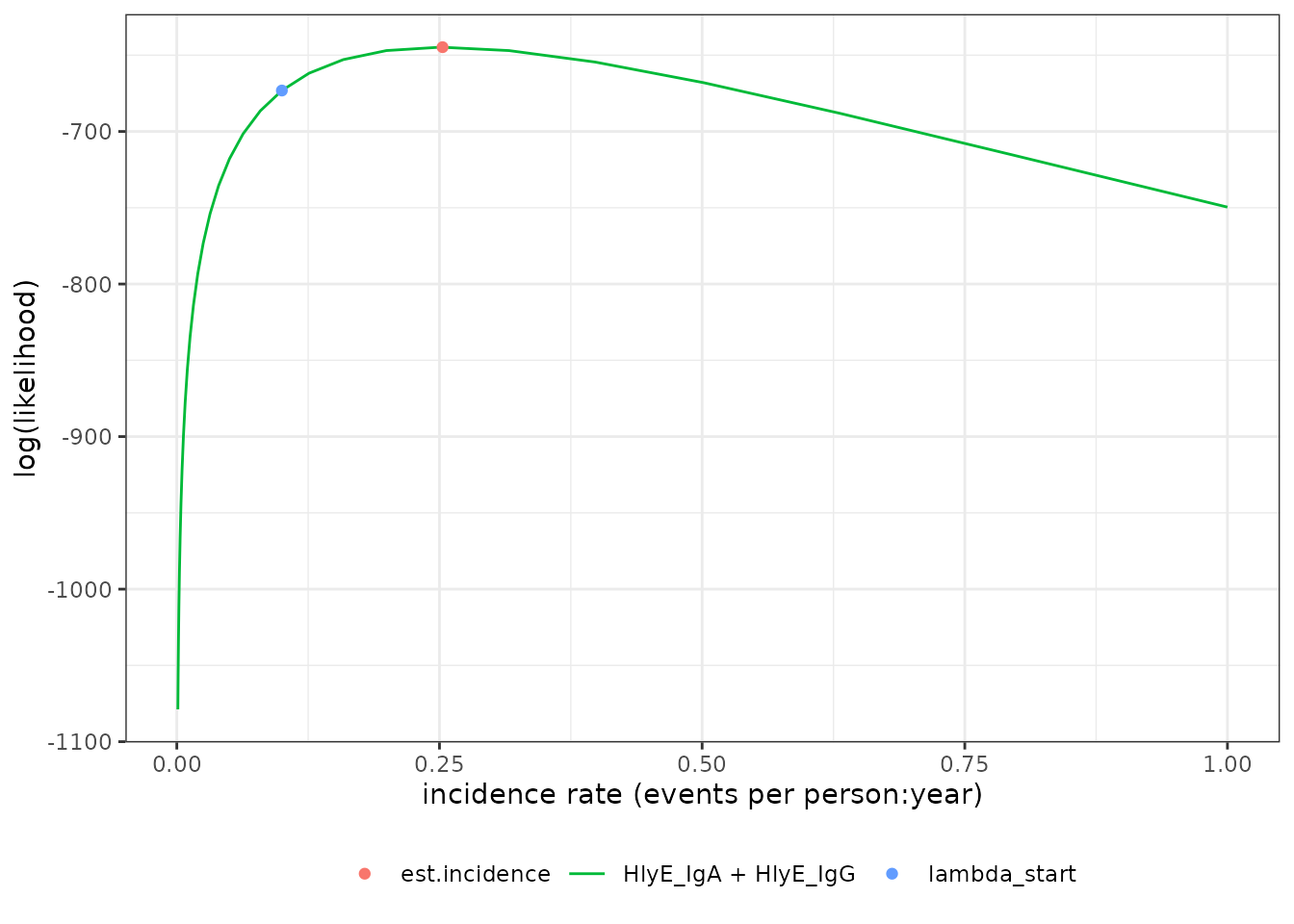
We can set the x-axis to a logarithmic scale:
autoplot(est1, log_x = TRUE)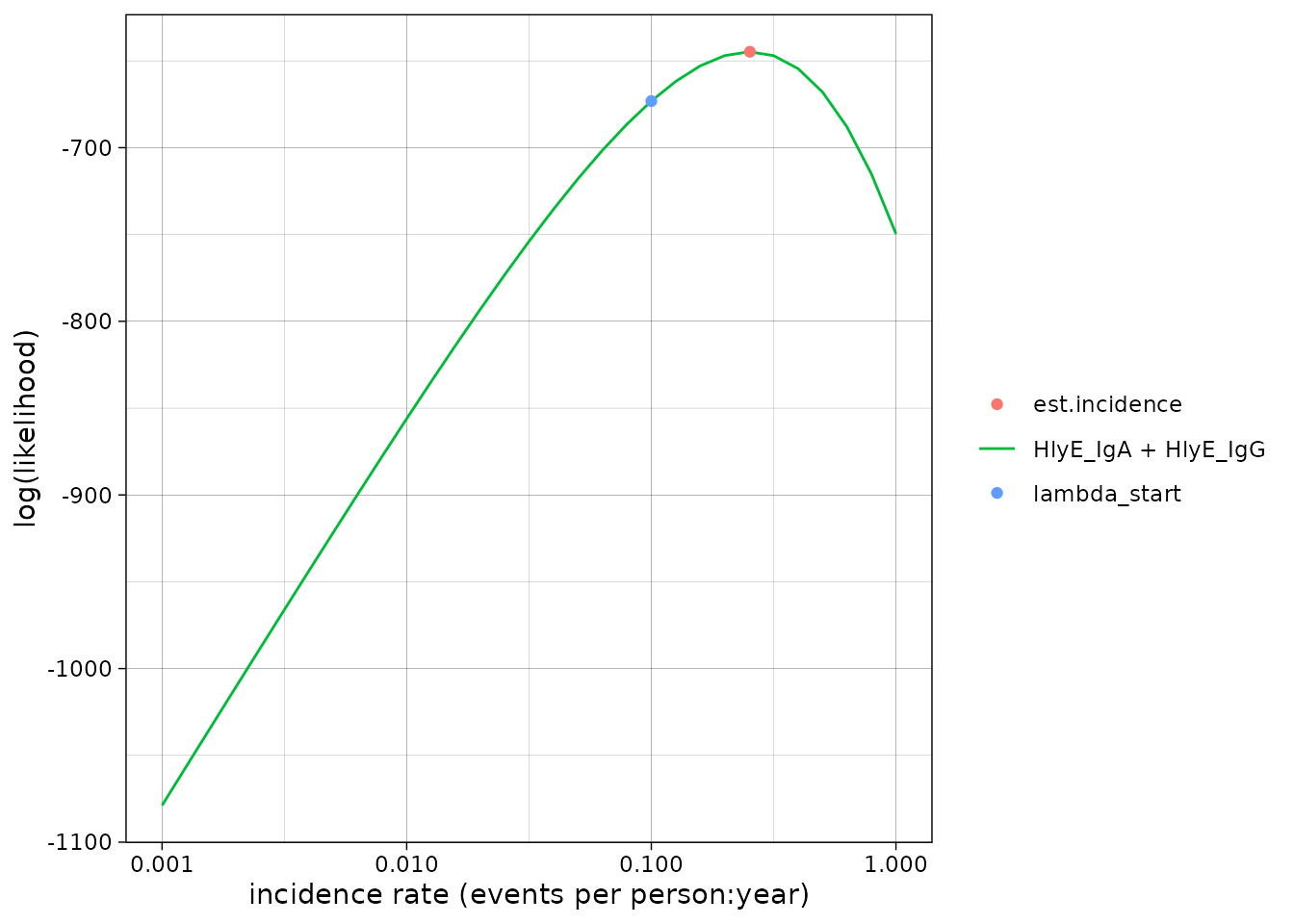
Simulate multiple clusters with different lambdas
library(parallel)
n_cores <- max(1, parallel::detectCores() - 1)
print(n_cores)
#> [1] 3
In the preceding code chunk, we have determined that we can use 3 CPU cores to run computations in parallel.
# number of clusters
nclus <- 5
# cross-sectional sample size
nrep <- 100

# incidence rate in e
lambdas <- c(.05, .1, .15, .2, .5, .8)

sim_df <-
  sim_pop_data_multi(
    n_cores = n_cores,
    lambdas = lambdas,
    nclus = nclus,
    n_samples = nrep,
    age_range = lifespan,
    antigen_isos = antibodies,
    renew_params = renew_params,
    add_noise = TRUE,
    curve_params = dmcmc,
    noise_limits = dlims,
    format = "long"
  )

print(sim_df)
#> # A tibble: 6,000 × 6
#>      age id    antigen_iso value lambda.sim cluster
#>    <dbl> <chr> <chr>       <dbl>      <dbl>   <int>
#>  1  3.53 1     HlyE_IgA    0.842       0.05       1
#>  2  3.53 1     HlyE_IgG    0.767       0.05       1
#>  3  2.27 2     HlyE_IgA    0.428       0.05       1
#>  4  2.27 2     HlyE_IgG    0.544       0.05       1
#>  5  9.05 3     HlyE_IgA    0.528       0.05       1
#>  6  9.05 3     HlyE_IgG    0.768       0.05       1
#>  7  5.94 4     HlyE_IgA    0.412       0.05       1
#>  8  5.94 4     HlyE_IgG    0.683       0.05       1
#>  9  9.88 5     HlyE_IgA    0.467       0.05       1
#> 10  9.88 5     HlyE_IgG    0.285       0.05       1
#> # ℹ 5,990 more rows
We can plot the distributions of the simulated responses:
sim_df |>
  ggplot() +
  aes(
    x = as.factor(cluster),
    y = value
  ) +
  geom_beeswarm(size = .2, alpha = .3, aes(color = antigen_iso)) +
  geom_boxplot(outlier.colour = NA, fill = NA) +
  scale_y_log10() +
  facet_wrap(~ antigen_iso + lambda.sim, nrow = 2) +
  theme_linedraw()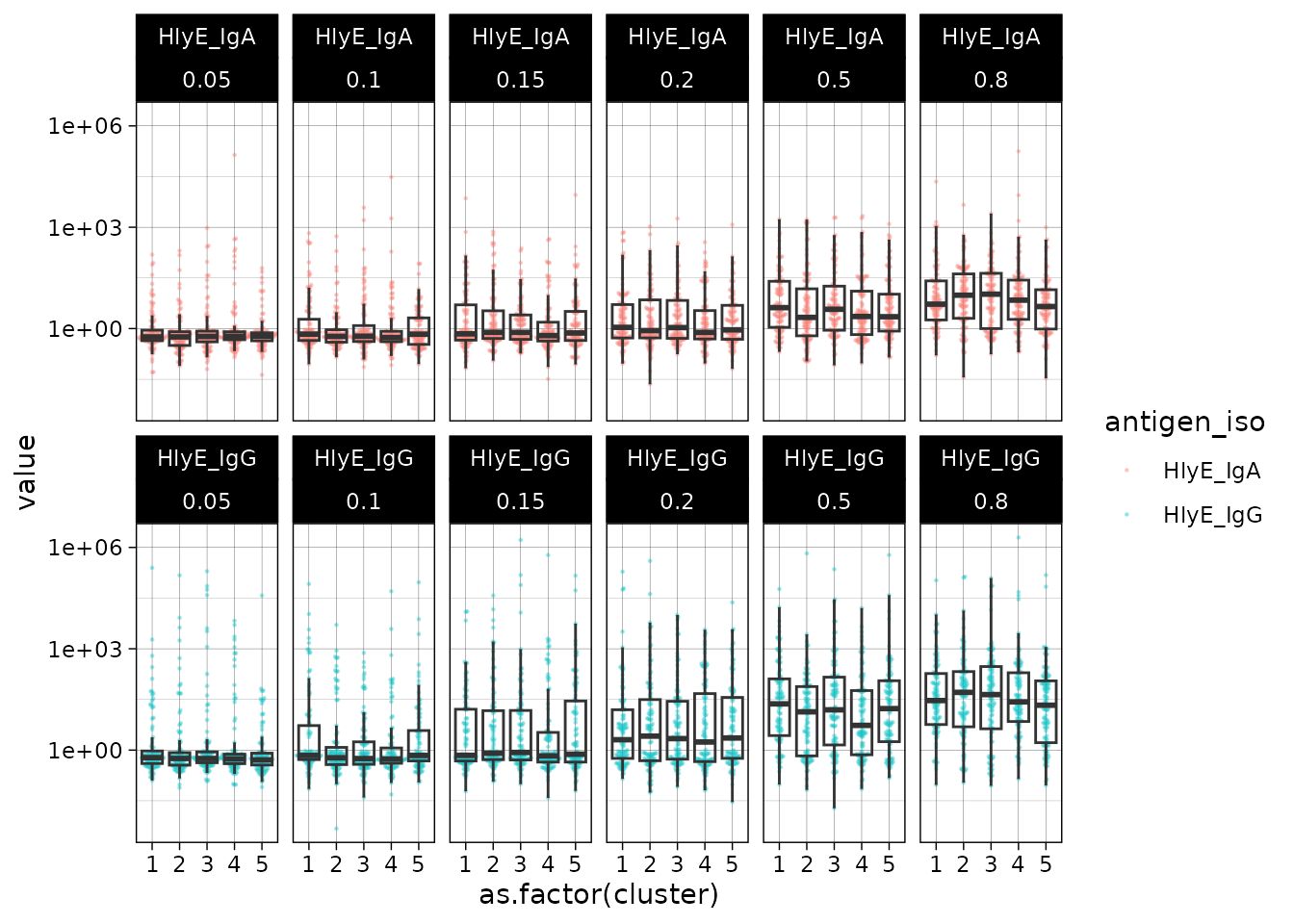
Estimate incidence in each cluster
ests <-
  est.incidence.by(
    pop_data = sim_df,
    curve_params = dmcmc,
    noise_params = cond,
    num_cores = n_cores,
    strata = c("lambda.sim", "cluster"),
    curve_strata_varnames = NULL,
    noise_strata_varnames = NULL,
    verbose = verbose,
    build_graph = TRUE, # slows down the function substantially
    antigen_isos = c("HlyE_IgG", "HlyE_IgA")
  )
summary(ests) produces a tibble() with some
extra meta-data:
ests_summary <- ests |> summary() |> print()
#> Warning in sqrt(var_log_lambda): NaNs produced
#> Warning in sqrt(var_log_lambda): NaNs produced
#> Seroincidence estimated given the following setup:
#> a) Antigen isotypes   : HlyE_IgG, HlyE_IgA
#> b) Strata       : lambda.sim, cluster
#>
#>  Seroincidence estimates:
#> # A tibble: 30 × 14
#>    Stratum    lambda.sim cluster     n est.start incidence.rate      SE CI.lwr
#>    <chr>           <dbl>   <int> <int>     <dbl>          <dbl>   <dbl>  <dbl>
#>  1 Stratum 1        0.05       1   100       0.1         0.0741 0.0111  0.0552
#>  2 Stratum 2        0.05       2   100       0.1         0.0605 0.00992 0.0438
#>  3 Stratum 3        0.05       3   100       0.1         0.0553 0.00952 0.0395
#>  4 Stratum 4        0.05       4   100       0.1         0.0535 0.00930 0.0381
#>  5 Stratum 5        0.05       5   100       0.1         0.0522 0.00898 0.0372
#>  6 Stratum 6        0.1        1   100       0.1         0.0928 0.0131  0.0703
#>  7 Stratum 7        0.1        2   100       0.1         0.0808 0.0123  0.0600
#>  8 Stratum 8        0.1        3   100       0.1         0.0864 0.0547  0.0250
#>  9 Stratum 9        0.1        4   100       0.1         0.0735 0.0112  0.0545
#> 10 Stratum 10       0.1        5   100       0.1         0.117  0.0149  0.0911
#> # ℹ 20 more rows
#> # ℹ 6 more variables: CI.upr <dbl>, coverage <dbl>, log.lik <dbl>,
#> #   iterations <int>, antigen.isos <chr>, nlm.convergence.code <ord>
We can explore the summary table interactively using
DT::datatable()
library(DT)
ests_summary |>
  DT::datatable(options = list(scrollX = TRUE)) |>
  DT::formatRound(
    columns = c(
      "incidence.rate",
      "SE",
      "CI.lwr",
      "CI.upr",
      "log.lik"
    )
  )
We can plot the likelihood for a single simulated cluster by
subsetting that simulation in ests and calling
plot():
autoplot(ests[1])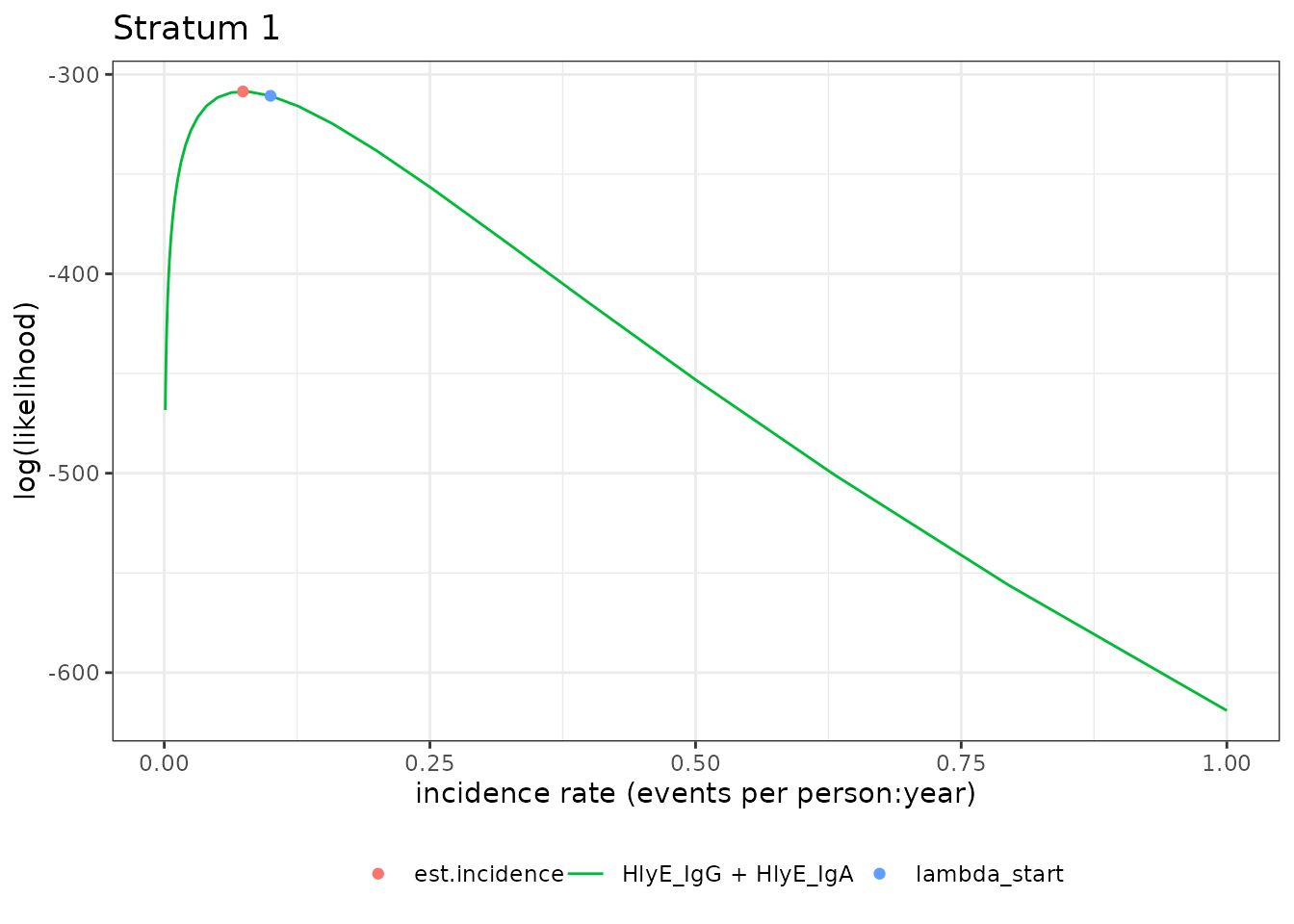
We can also plot log-likelihood curves for several clusters at once (your computer might struggle to plot many at once):
autoplot(ests[1:5])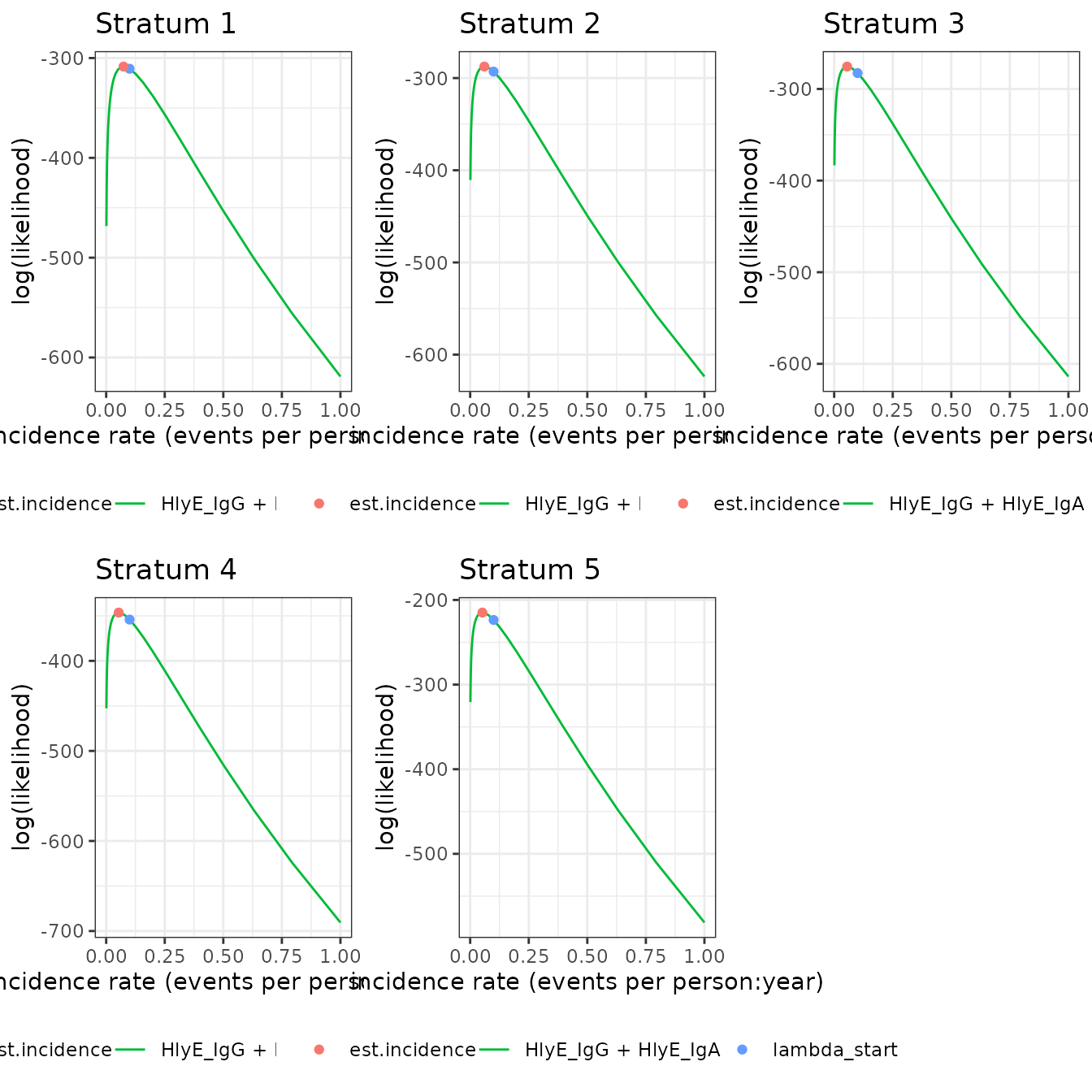
The log_x argument also works here:
autoplot(ests[1:5], log_x = TRUE)
nlm() convergence codes
Make sure to check the nlm() exit codes (codes 3-5
indicate possible non-convergence):
ests_summary |>
  as_tibble() |> # removes extra meta-data
  select(Stratum, nlm.convergence.code) |>
  filter(nlm.convergence.code > 2)
#> # A tibble: 2 × 2
#>   Stratum    nlm.convergence.code
#>   <chr>      <ord>
#> 1 Stratum 11 3
#> 2 Stratum 27 3
Solutions to nlm() exit codes 3-5:
- 3: decrease the
stepminargument toest.incidence()/est.incidence.by() - 4: increase the
iterlimargument toest.incidence()/est.incidence.by() - 5: increase the
stepmaxargument toest.incidence()/est.incidence.by()
We can extract the indices of problematic strata, if there are any:
If any clusters had problems, we can take a look:
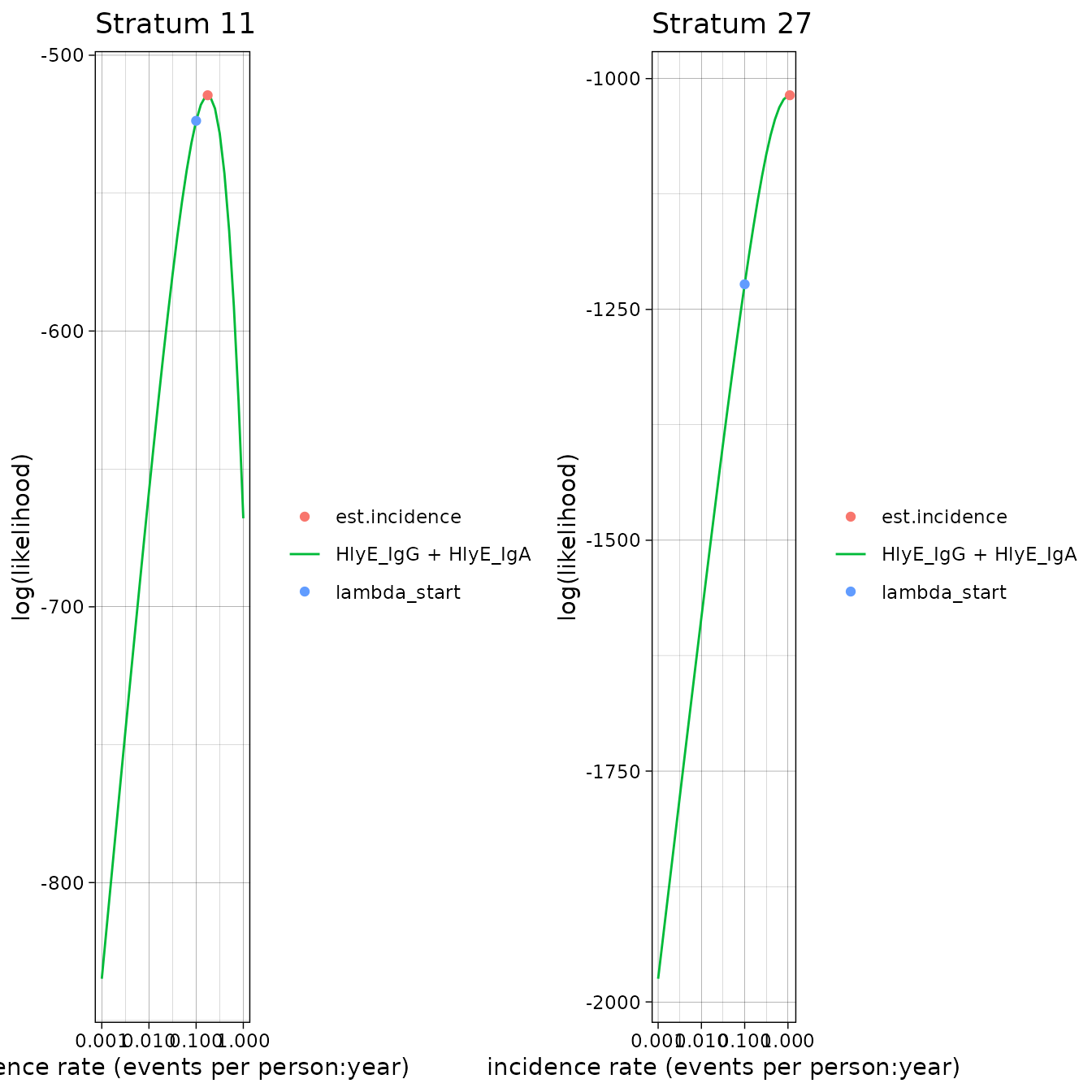
If any of the fits don’t appear to be at the maximum likelihood, we
should re-run those clusters, adjusting the nlm() settings
appropriately, to be sure.
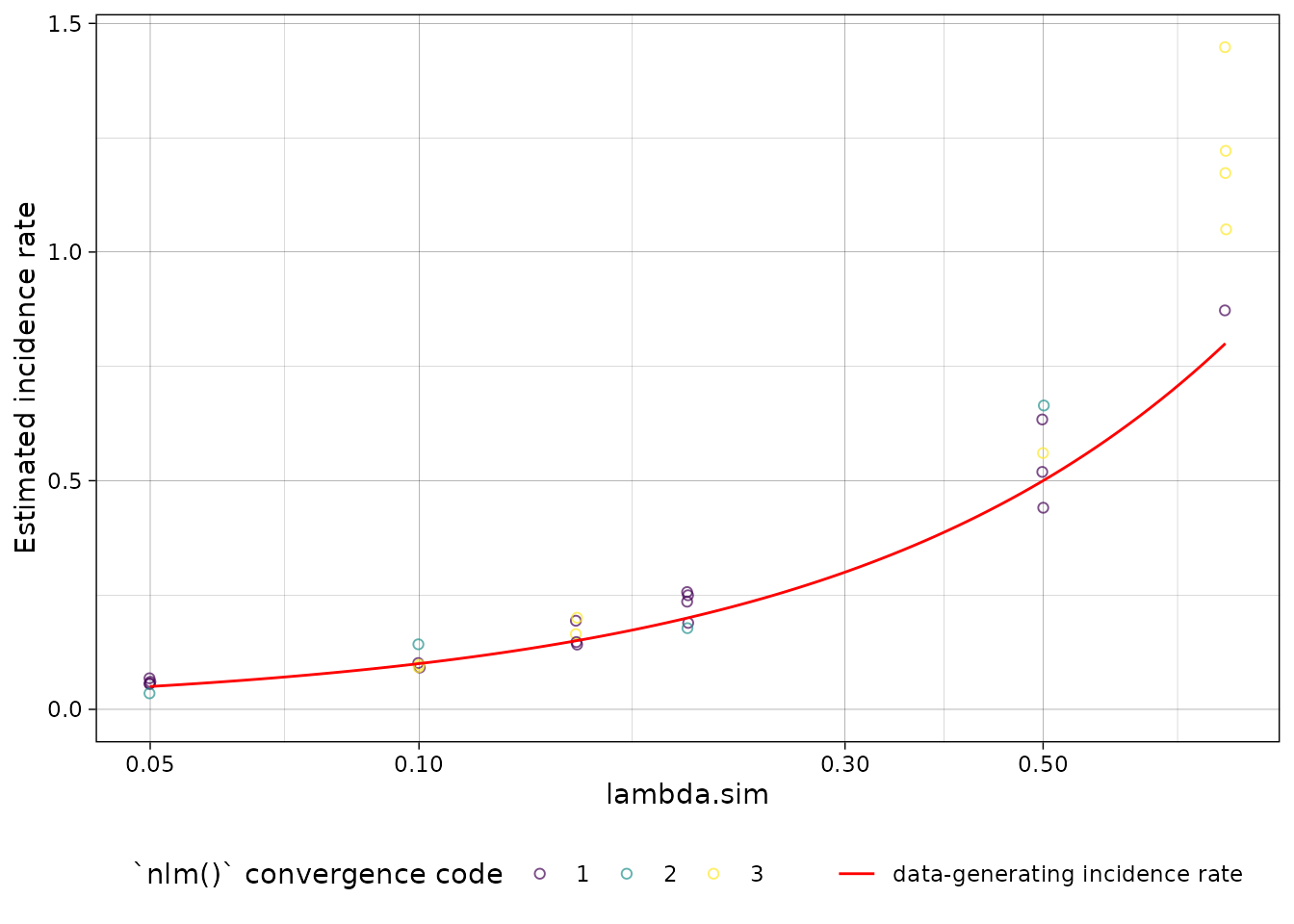
plot distribution of estimates by simulated incidence rate
Finally, we can look at our simulation results:
library(ggplot2)
ests_summary |>
  autoplot(xvar = "lambda.sim") +
  ggplot2::geom_function(
    fun = function(x) x,
    col = "red",
    aes(linetype = "data-generating incidence rate")
  ) +
  labs(linetype = "") +
  scale_x_log10()
#> Warning in scale_x_log10(): log-10 transformation introduced
#> infinite values.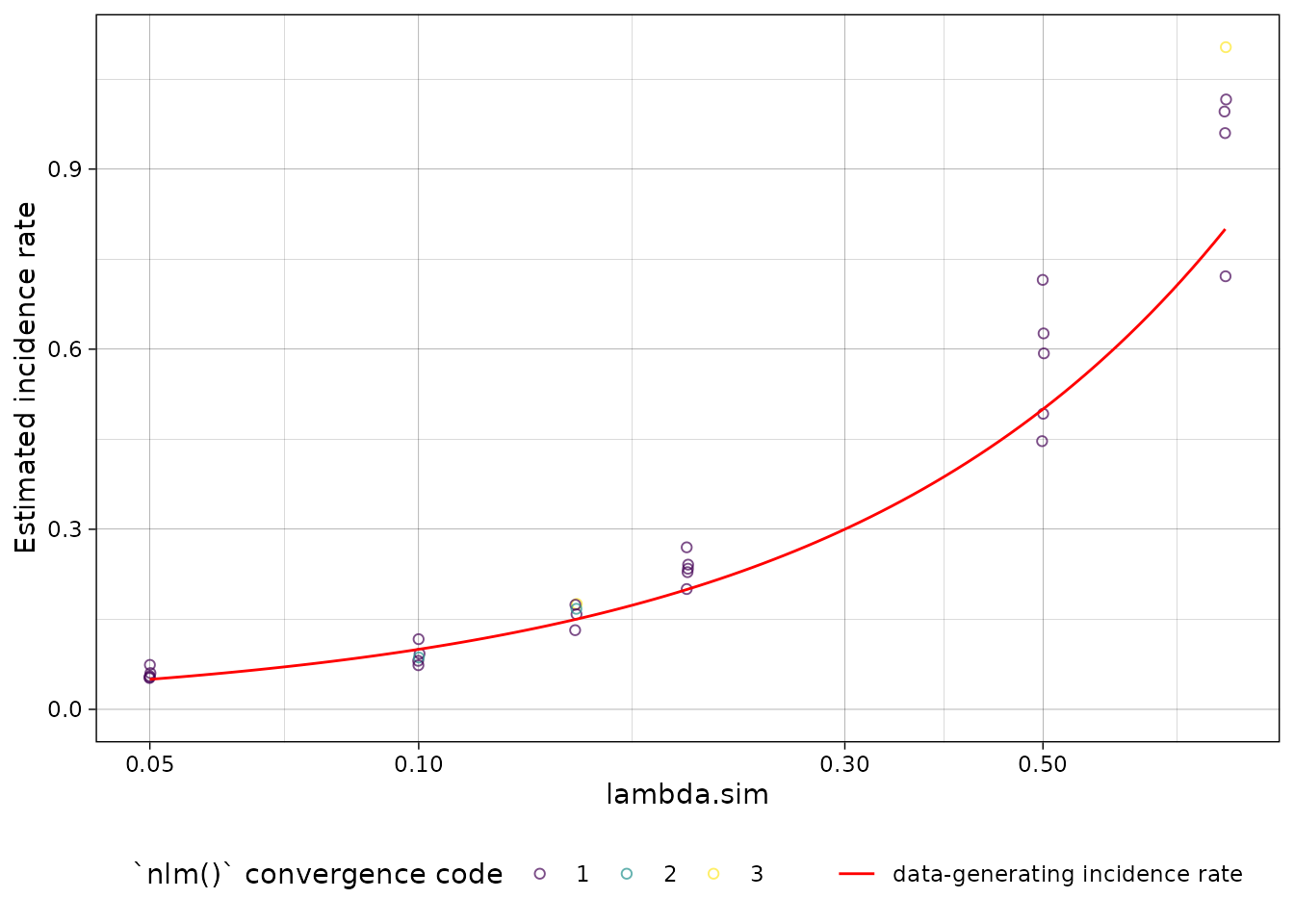
Effect of renew_params
Setting renew_params = TRUE is more realistic, but not
is accounted for by the current method; for population samples from
populations with high incidence rates, there may be bias:
sim_df_renew <-
  sim_pop_data_multi(
    n_cores = n_cores,
    lambdas = lambdas,
    nclus = nclus,
    n_samples = nrep,
    age_range = lifespan,
    antigen_isos = antibodies,
    renew_params = TRUE,
    add_noise = TRUE,
    curve_params = dmcmc,
    noise_limits = dlims,
    format = "long"
  )

ests_renew <-
  est.incidence.by(
    pop_data = sim_df_renew,
    curve_params = dmcmc,
    noise_params = cond,
    num_cores = n_cores,
    strata = c("lambda.sim", "cluster"),
    curve_strata_varnames = NULL,
    noise_strata_varnames = NULL,
    verbose = verbose,
    build_graph = TRUE, # slows down the function substantially
    antigen_isos = c("HlyE_IgG", "HlyE_IgA")
  )
ests_renew_summary <-
  ests_renew |> summary()
#> Warning in sqrt(var_log_lambda): NaNs produced
#> Warning in sqrt(var_log_lambda): NaNs produced
#> Warning in sqrt(var_log_lambda): NaNs produced
#> Warning in sqrt(var_log_lambda): NaNs produced
ests_renew_summary |>
  autoplot(xvar = "lambda.sim") +
  ggplot2::geom_function(
    fun = function(x) x,
    col = "red",
    aes(linetype = "data-generating incidence rate")
  ) +
  labs(linetype = "") +
  scale_x_log10()
#> Warning in scale_x_log10(): log-10 transformation introduced
#> infinite values.